Pet Handoff Banner
Case Study · 02

Pet Handoff

Shared care handoff cards for couples & roommates

Role
UX / UI Designer
Type
Mobile App Design
Tools
Figma
Overview

Project Summary

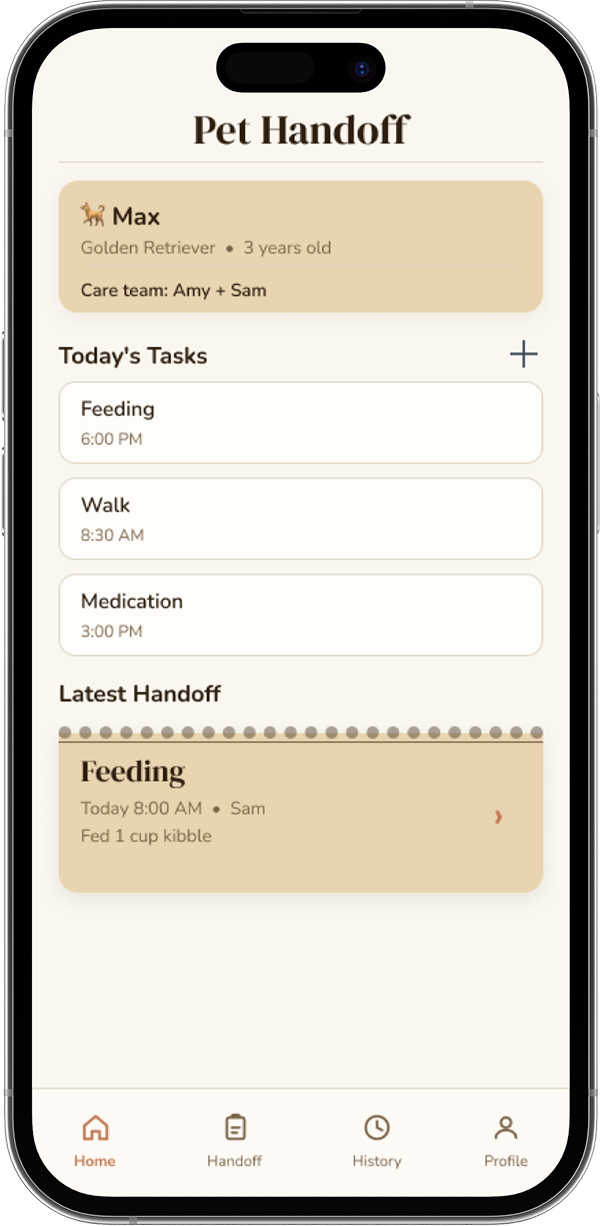
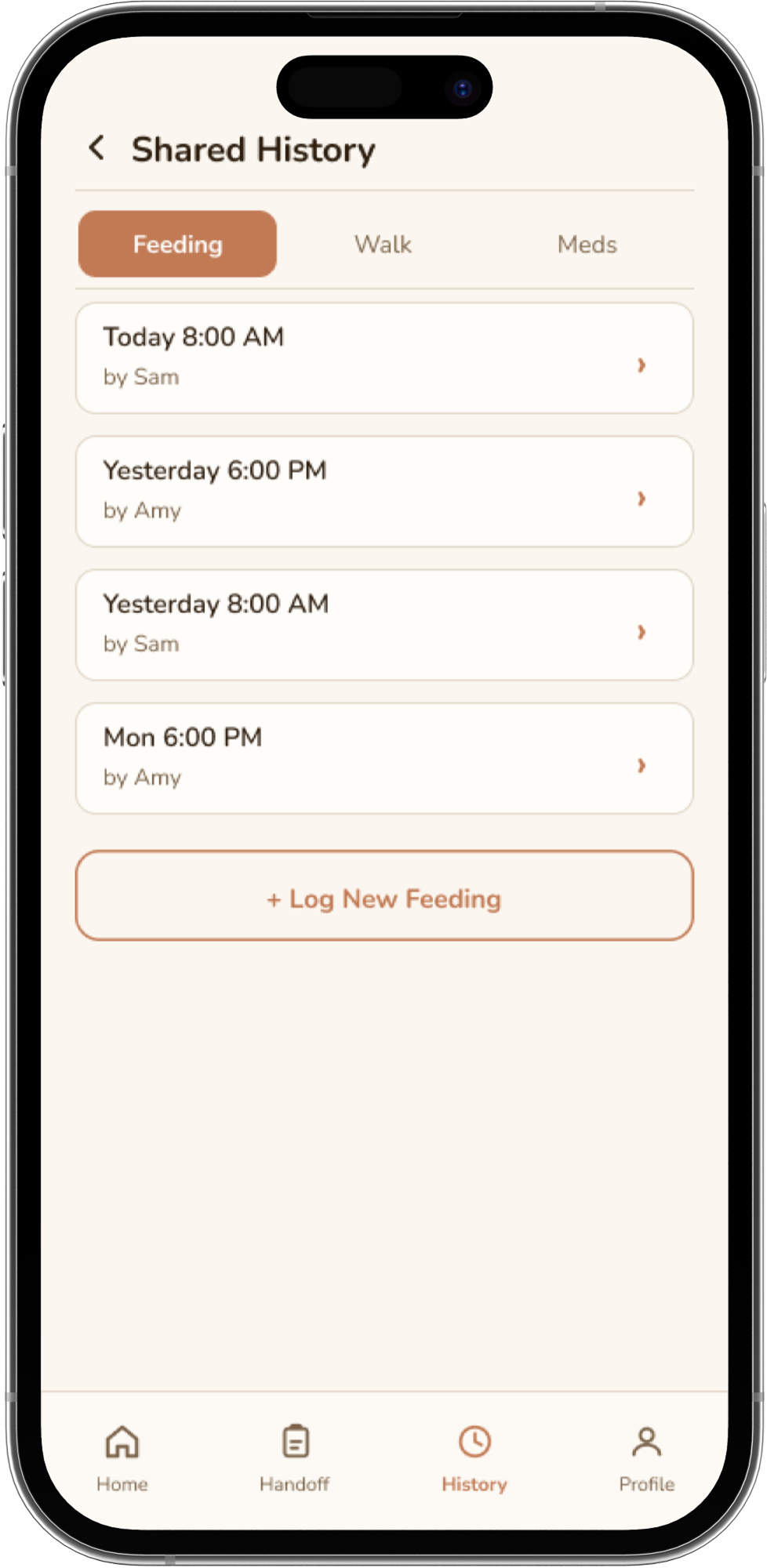
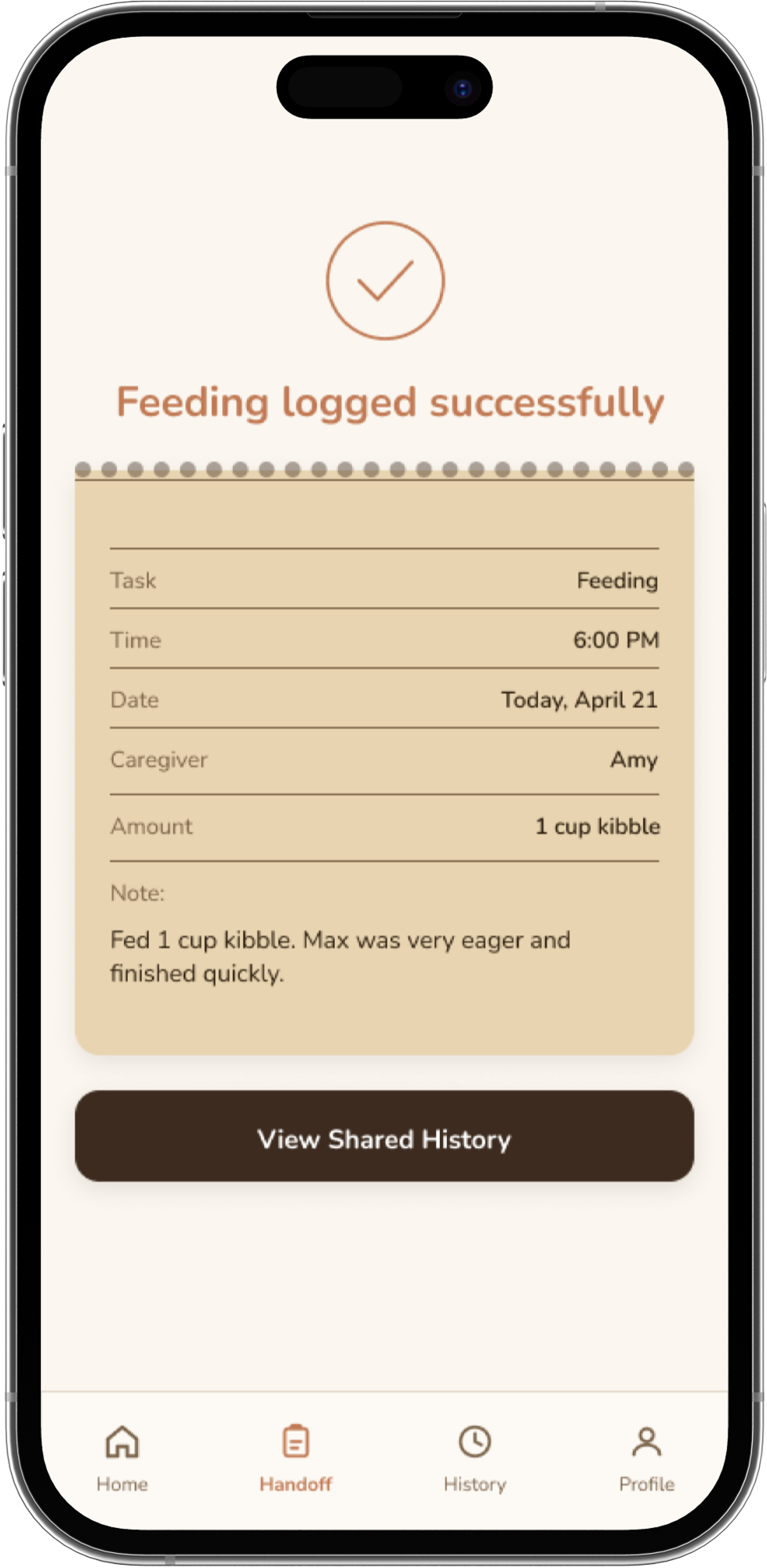
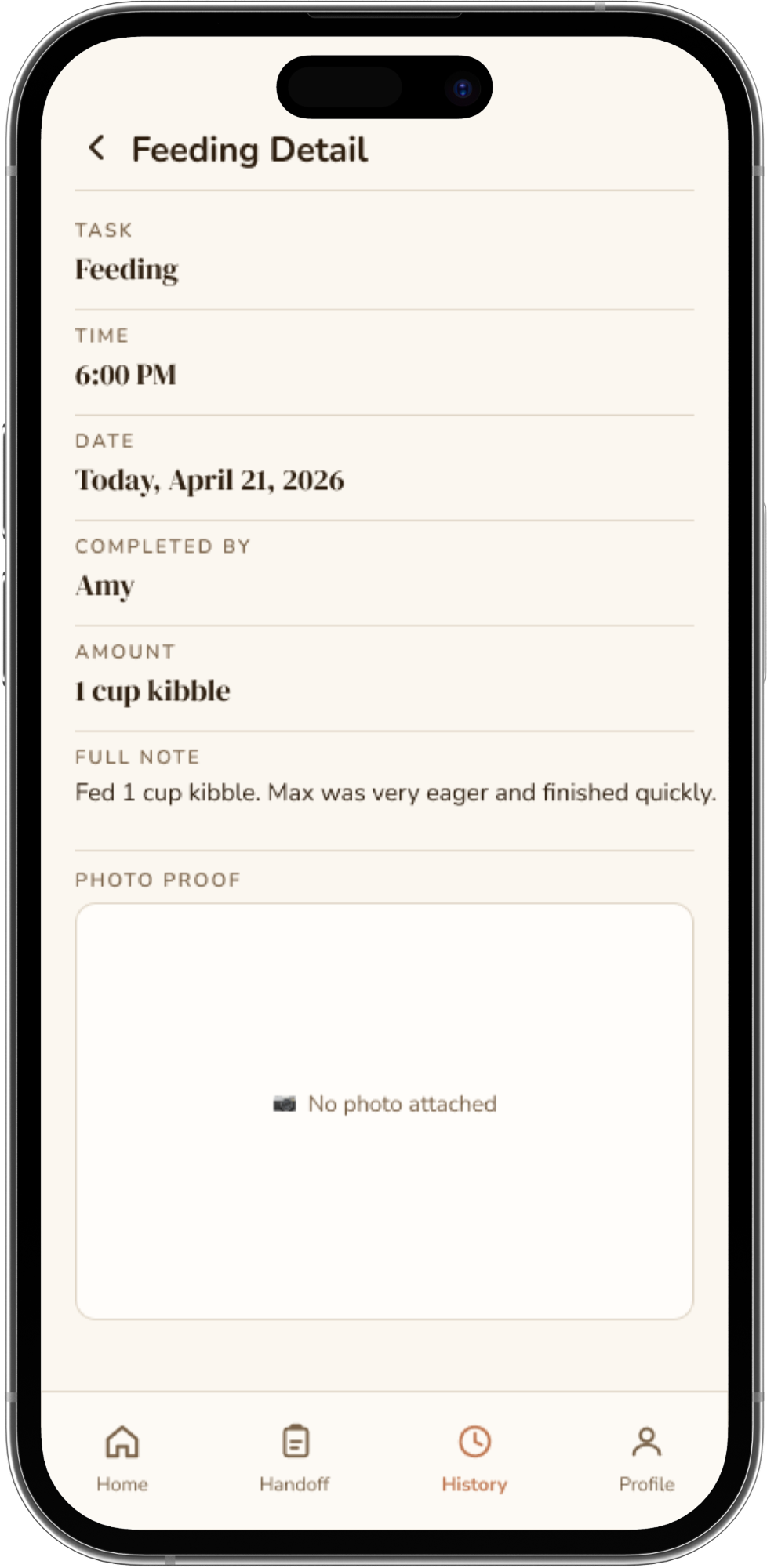
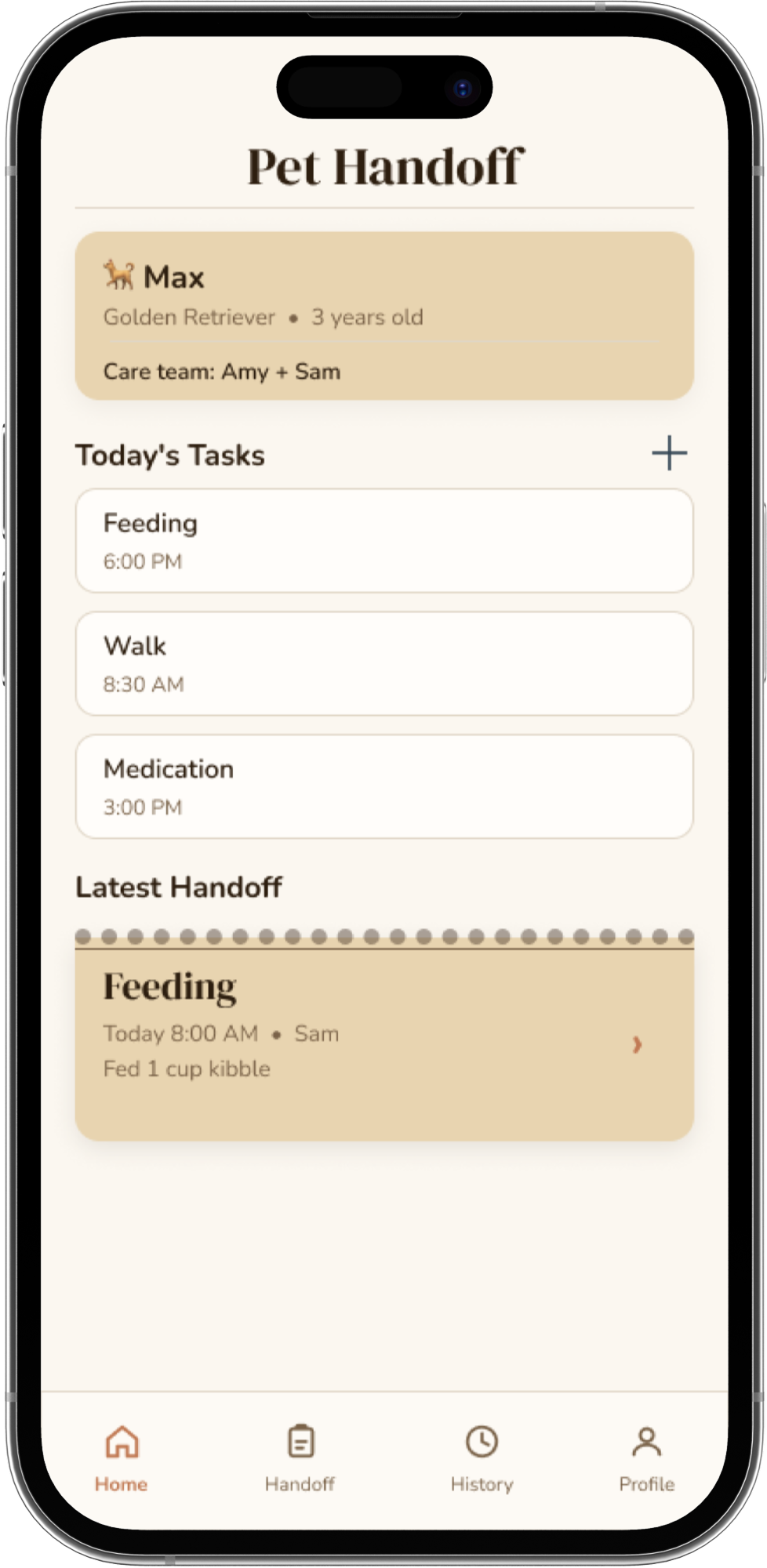
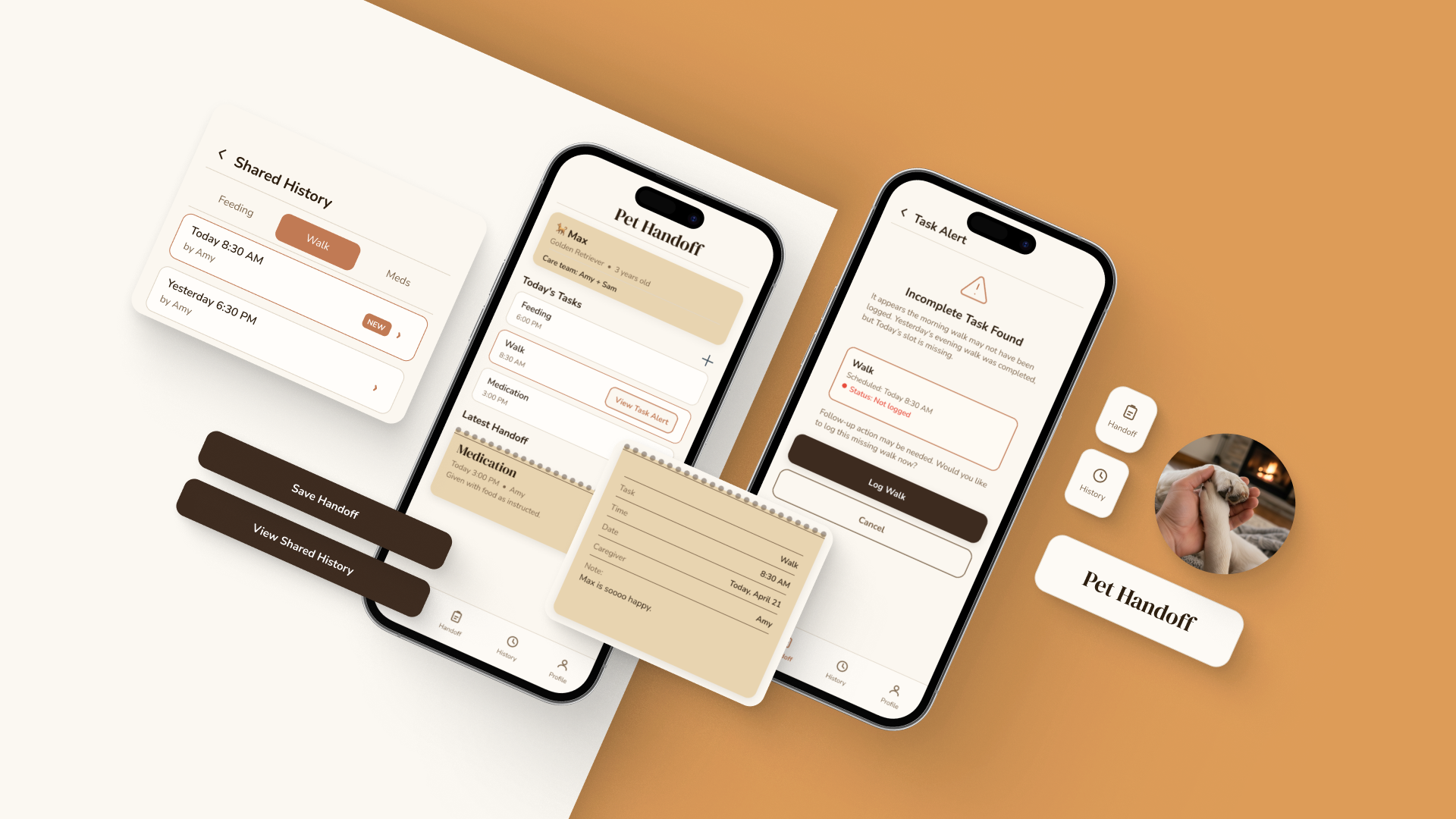
Pet Handoff is a shared pet care coordination system designed for couples or roommates who share responsibility for a dog or cat. The system turns everyday care actions into receipt-like confirmations that clearly show who completed a task and when it was done. Each action creates a simple record with a timestamp, optional notes, and photo proof.

Mission
Reduce confusion and conflict in shared pet care by providing clear, traceable handoffs between caregivers.
Core System
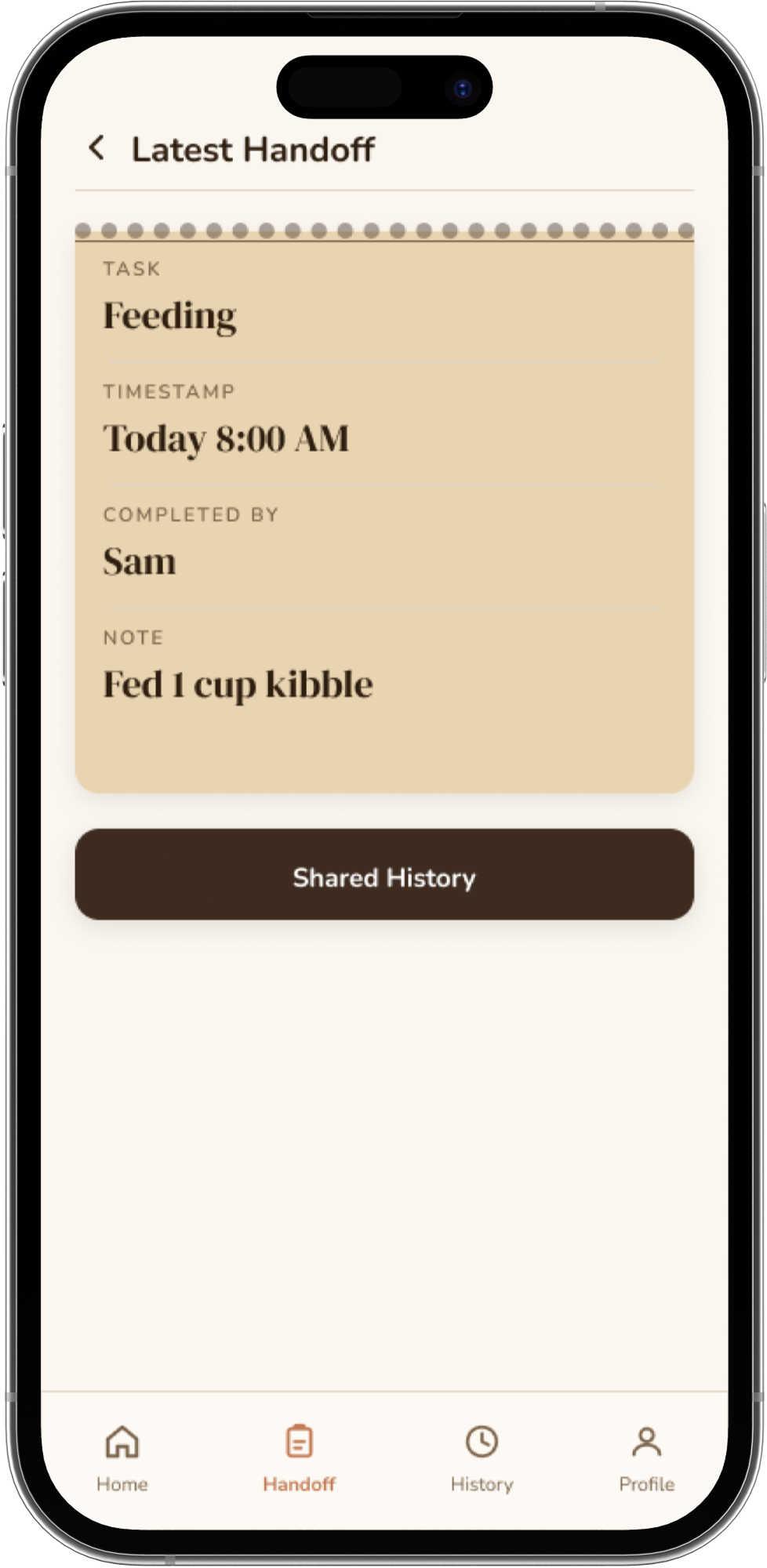
Receipt-like handoff cards with timestamps, optional notes, and photo proof. Inspired by Apple Wallet transaction records.
Outcome
High-fidelity proof of concept covering feeding, medication, and walk handoff flows with shared history and task alerts.
Pet Handoff App Mockup
The Problem

Why does shared pet care break down?

Shared pet care breaks down when schedules change. Tasks get missed or doubled because nobody knows what's already been done. Texts and memory work fine until they don't. There's no record to fall back on when something gets confused.

37%
of unmarried couples argue about household chores
87%
of pet owners say technology enhances their pet care

Sources: YouGov (Feb 2026), couples and household chores. Today's Veterinary Business pet technology survey (Dec 2024).

1
Missed medication tasks create real health risks. Double-dosing or skipping a dose can seriously harm a pet.
2
"Did you do it?" conversations cause daily tension in shared households, turning routine care into a source of conflict.
3
Without a visible handoff history, task ownership stays unclear and caregivers can't trust that shared routines are working.

"How might we help co-caregivers avoid missed or duplicated pet care tasks through clear, traceable handoffs?"

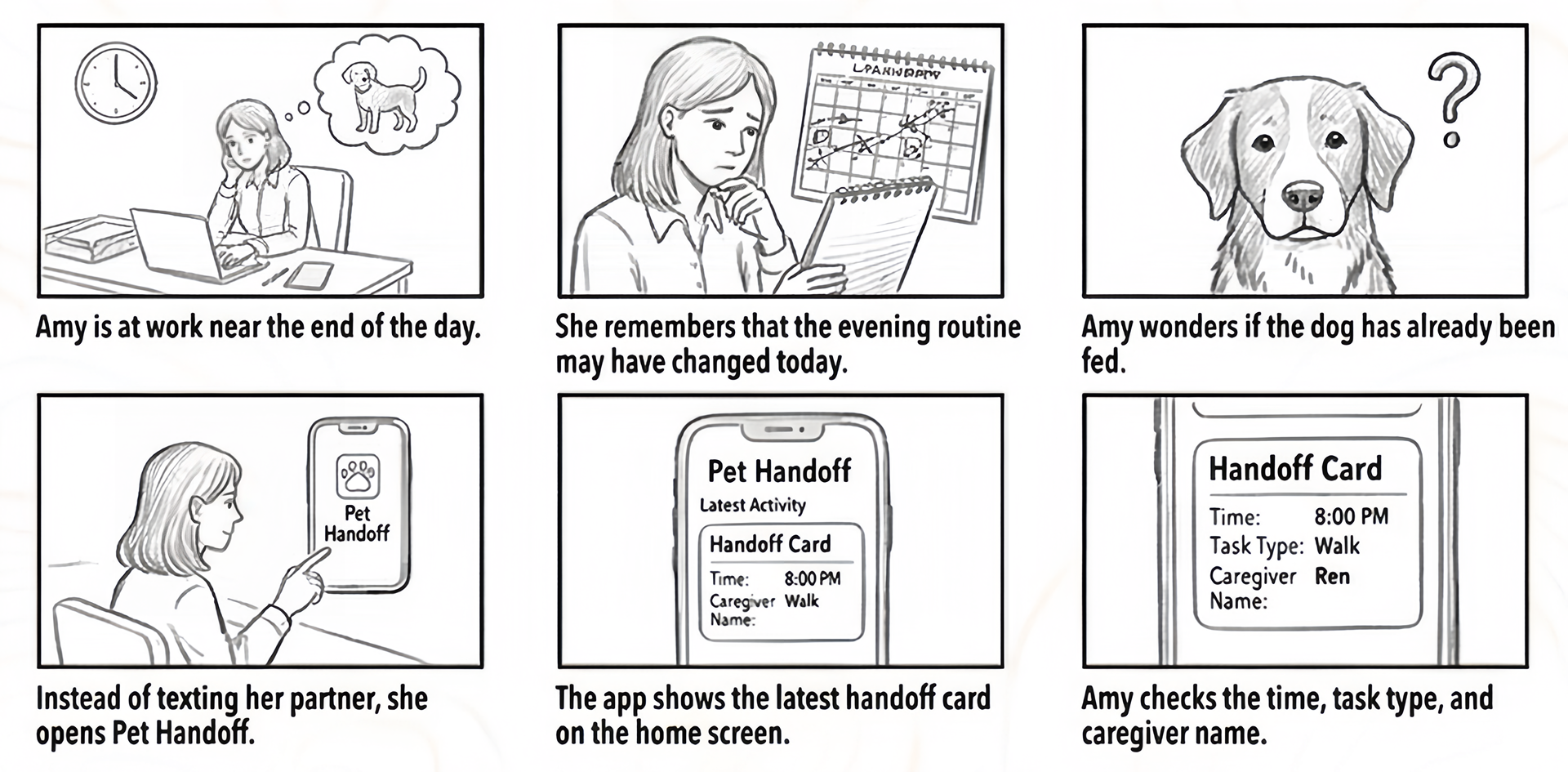
Pet Handoff scenario storyboard
Research

How I approached the problem

Goal
Understand why shared pet care creates friction and what caregivers actually need to feel confident about task completion

User Interview Insights

Interviews with participants who share pet care revealed three consistent patterns across households.

0%
often asked "Did you already feed/walk them?" to avoid repeating tasks
0%
accidentally repeated tasks because they were unsure if someone else had done it
0%
wanted a simple way to confirm task completion and see a shared care history

Competitive Landscape

Existing apps handle reminders well. None of them handle the handoff: telling the next person what already happened.

PetDesk
Tool Competitor
Strong for pet health tracking and appointment reminders.
Gap: Not designed for shared caregiver handoffs that clearly show who completed a care task and when.
Text Messages
Behavior Competitor
Familiar and immediately accessible for every household.
Gap: Messages are scattered, easy to miss, and don't create a reliable scannable history of care.

Expert Consultation

Eve Rodsky
Eve Rodsky
Shared Responsibility & Mental Load
Rodsky's Fair Play framework shows that conflict often grows when responsibilities are invisible and tracked mentally instead of visibly. In shared caregiving, people repeat the same "Did you do it?" conversation because task ownership is unclear.
→ Shaped Pet Handoff's shared history and receipt-like handoff cards, helping caregivers quickly verify completed tasks instead of relying on memory.
James Clear
James Clear
Habit Formation & Consistency
Clear argues that routines are easier to maintain when actions are clear, simple, and low-friction. If a task feels unclear or takes too many steps to confirm, people are more likely to delay it or assume someone else already did it.
→ Shaped Pet Handoff's one-tap confirmation flow and optional note/photo proof, making routine care faster to log while keeping the interaction simple.

Key Insights

The problem is not a lack of reminders. It's a lack of handoff clarity and visible confirmation.
Caregivers rely on texts and memory, which are scattered and create repeated "Did you do it?" conversations.
A simple, shared record with timestamps builds trust and reduces task duplication or missed care.

User Persona

Amy L.
28 · San Francisco · Primary Persona
"Did you already feed him? Was the dog walked yet?"
Primary Goal

Quickly confirm whether a task has been done without texting her partner.

Who She Is

Lives with her partner and their two-year-old dog. Both work busy schedules and split care throughout the day.

Main Frustrations
  • Routines shift often
  • Relies on texts and memory
  • Repeated tasks create tension
Product Needs
  • Shared, scannable record
  • One-tap logging
  • Alerts for missed tasks
Amy L.
Positioning

Unique Positioning

Research kept pointing to the same thing: people didn't need another reminder app. They needed a shared record. Pet Handoff gives caregivers a receipt-like log of who did what and when, so there's always something concrete to check.

Primary Audience
Couples or roommates who co-care for a dog or cat. Shared household, busy or changing schedules. Need clear handoffs to avoid missed or duplicated care tasks.
Secondary Audience
Families with multiple caregivers (partner, kids, roommates). Pet sitters and dog walkers who need clear routines and notes from owners.
Solution

Three Core Task Flows

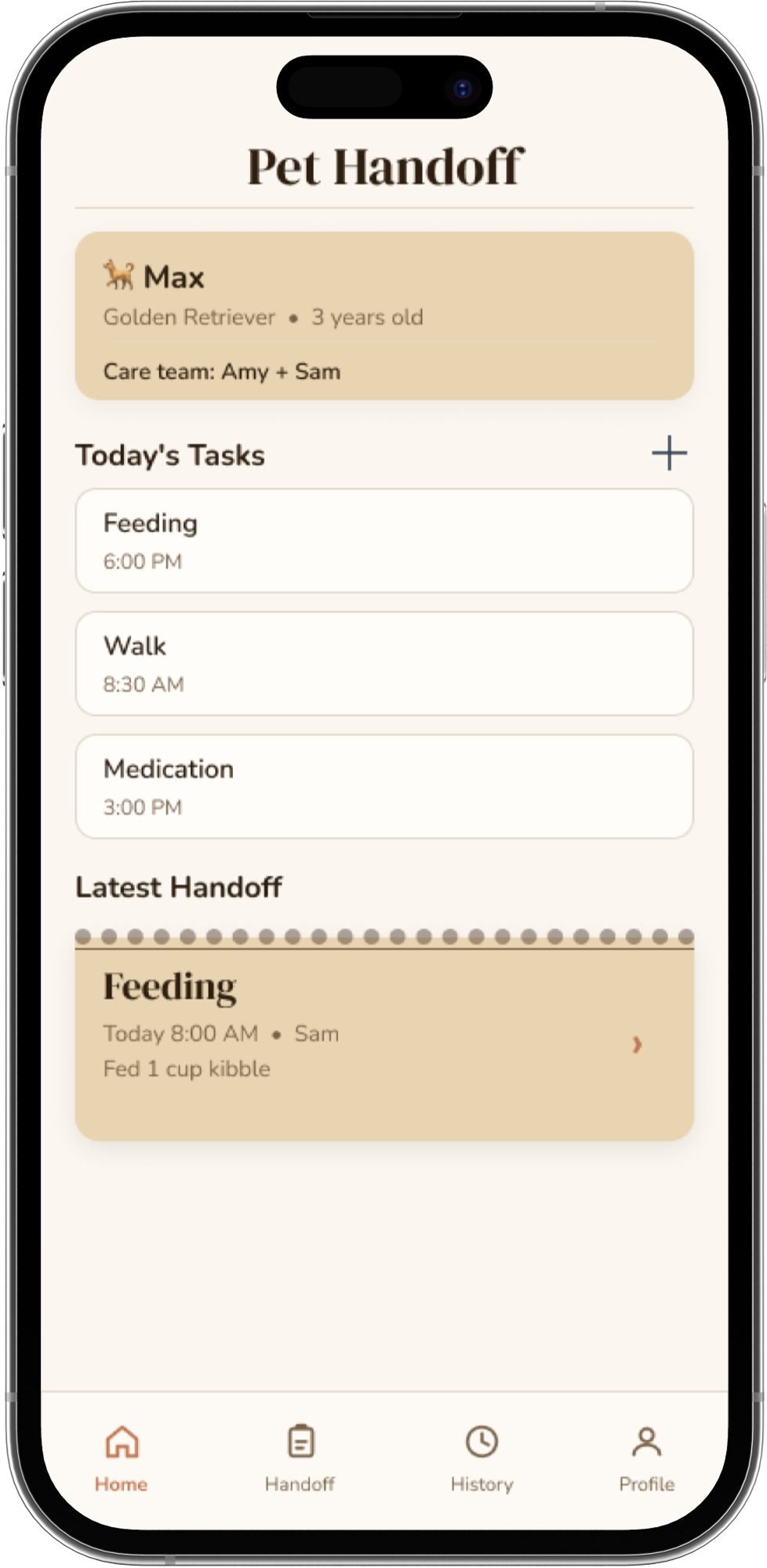
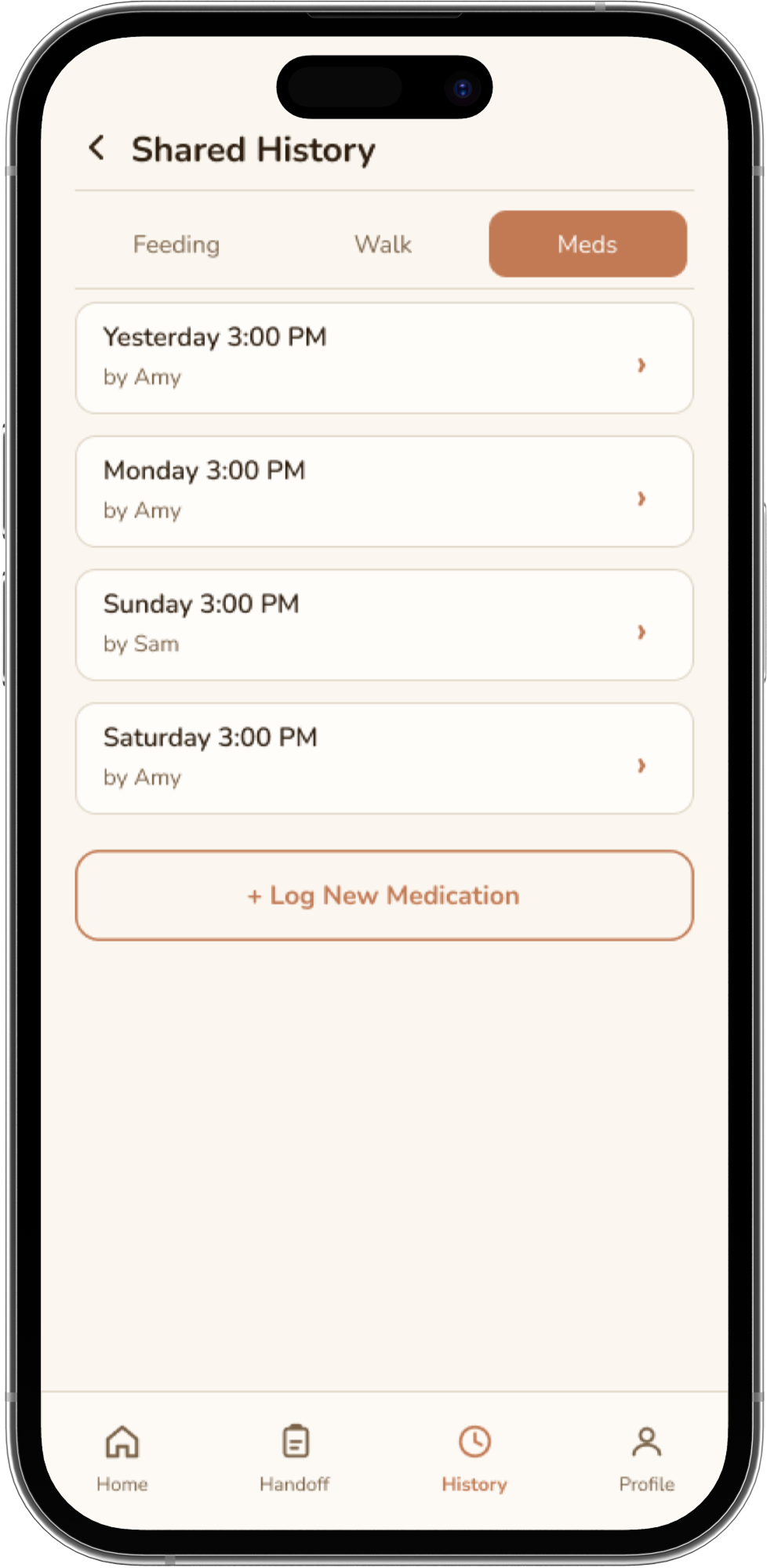
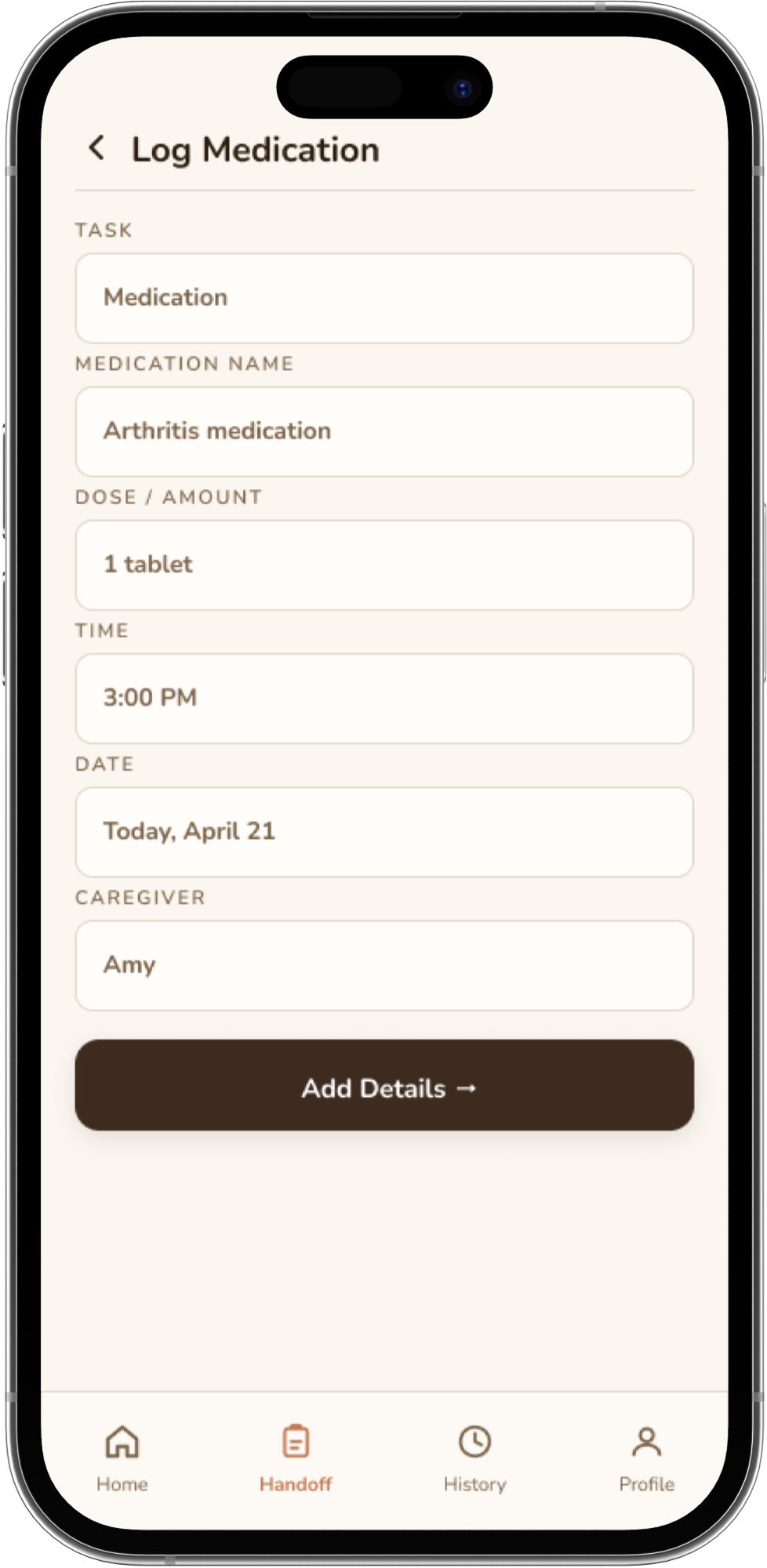
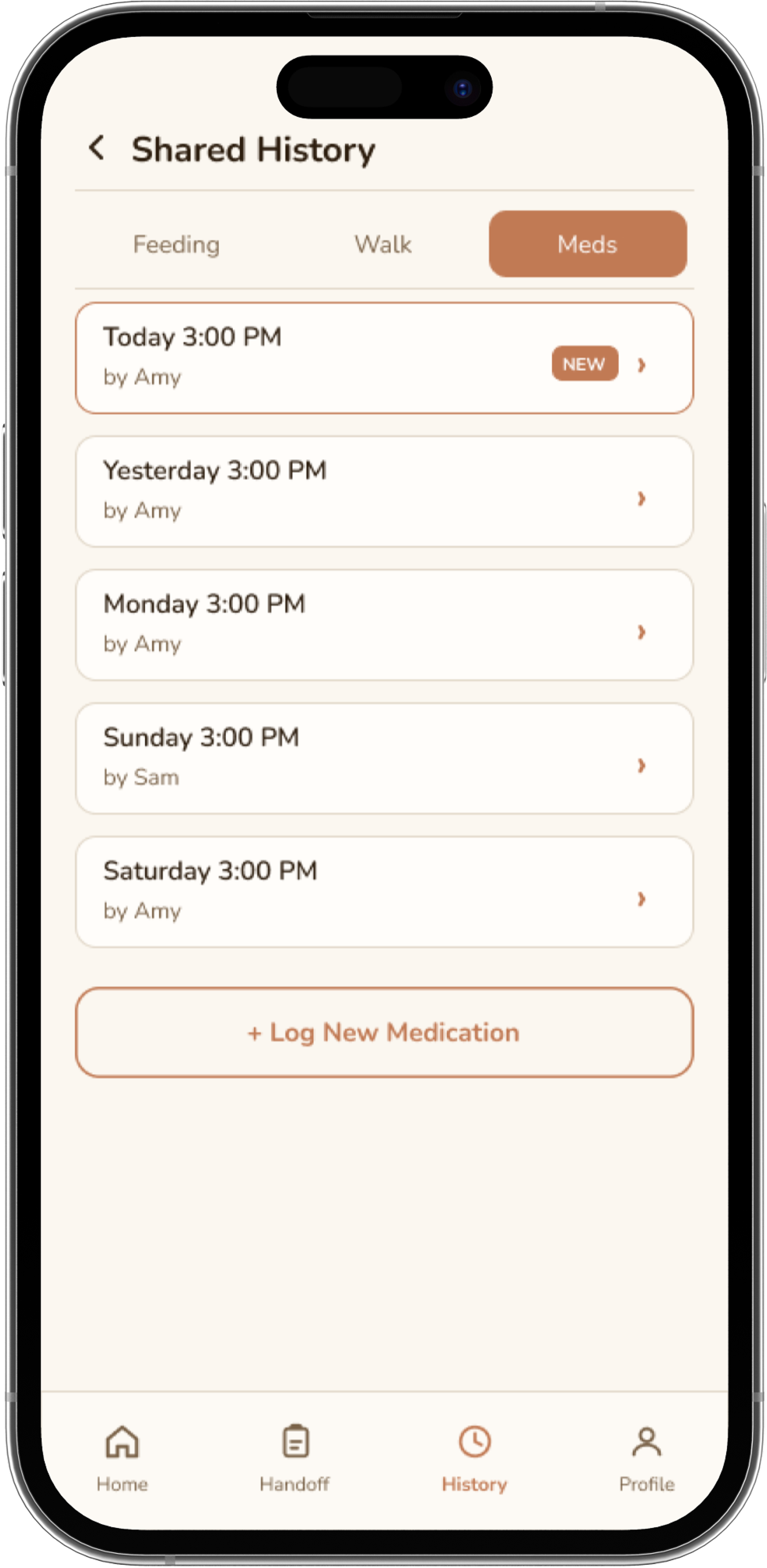
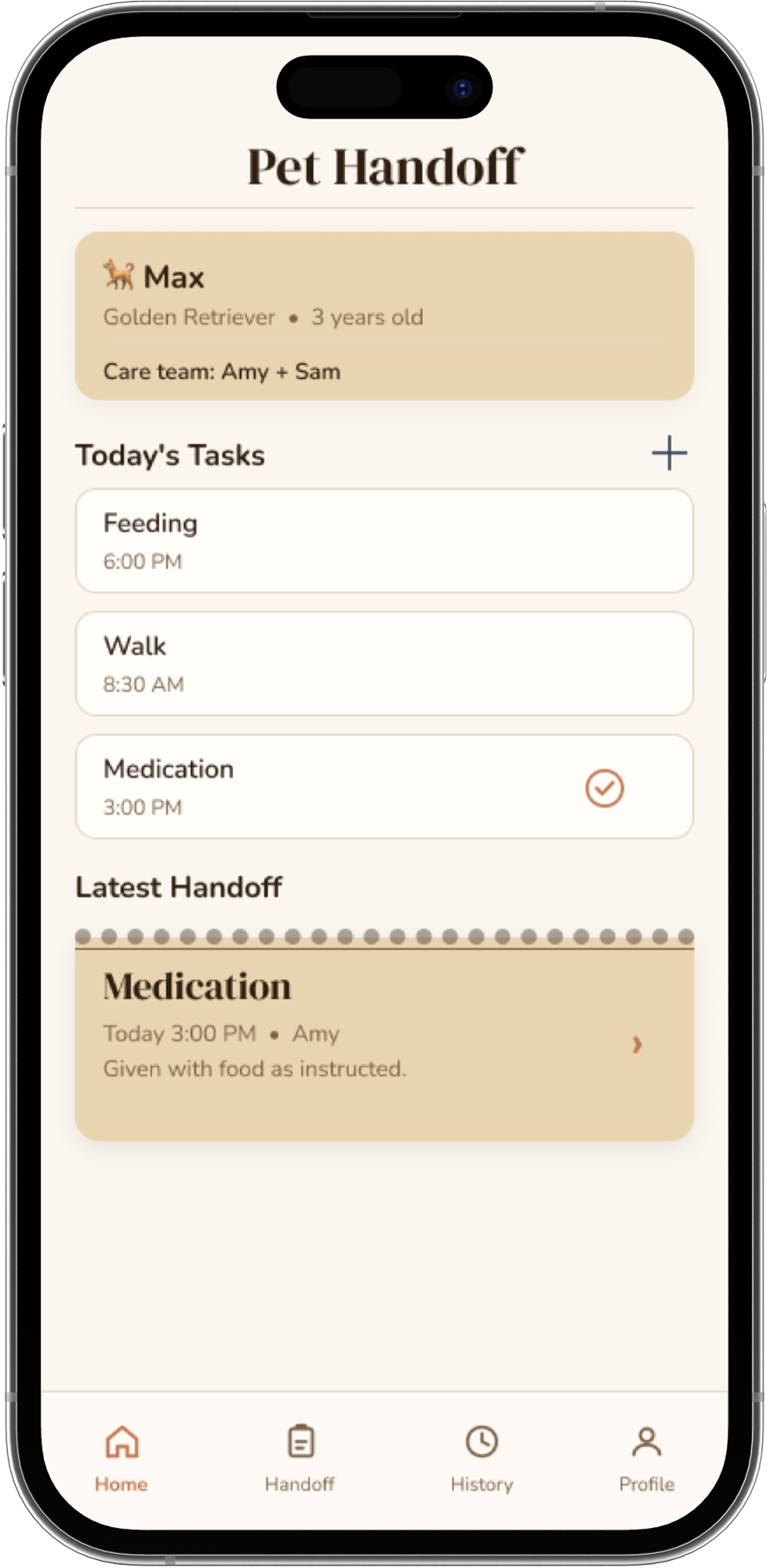
Three flows cover the most common and highest-risk care tasks: feeding, medication, and walks. Each one creates a clear record both caregivers can check.

Design

Visual Direction

Warm, grounded dark UI with amber accents. Designed to feel trustworthy, calm, and easy to scan.

#2D1E0F
Primary Text
Dark Brown
#7A6248
Secondary Text
Medium Brown
#C17A54
Accent
Terracotta
#E0D6C7
Border
Light Beige
#FBF7F0
Page Background
Warm Cream
#E8D4B0
Card Background
Warm Tan
#EB4C3C
Alert / Error
Red
DM Serif Display — Display / App Title — 30px Pet Handoff
DM Serif Display — Feature Heading — 22px Feeding
DM Serif Display — Card Heading — 17px Feeding
Nunito Bold — Section Header — 20px Latest Handoff
Nunito Bold — Body Emphasis — 15px Walk logged successfully
Nunito SemiBold — Label — 13px Care team: Amy + Sam
Nunito Regular — Body — 13px Golden Retriever • 3 years old
Nunito Regular — Detail — 12px 6:00 PM · Today 8:00 AM
Testing

What I learned from prototype testing

I ran paper prototype tests with testers on task clarity, alert visibility, flow logic, and shared history usability. Two issues emerged that required redesign before the final proof of concept.

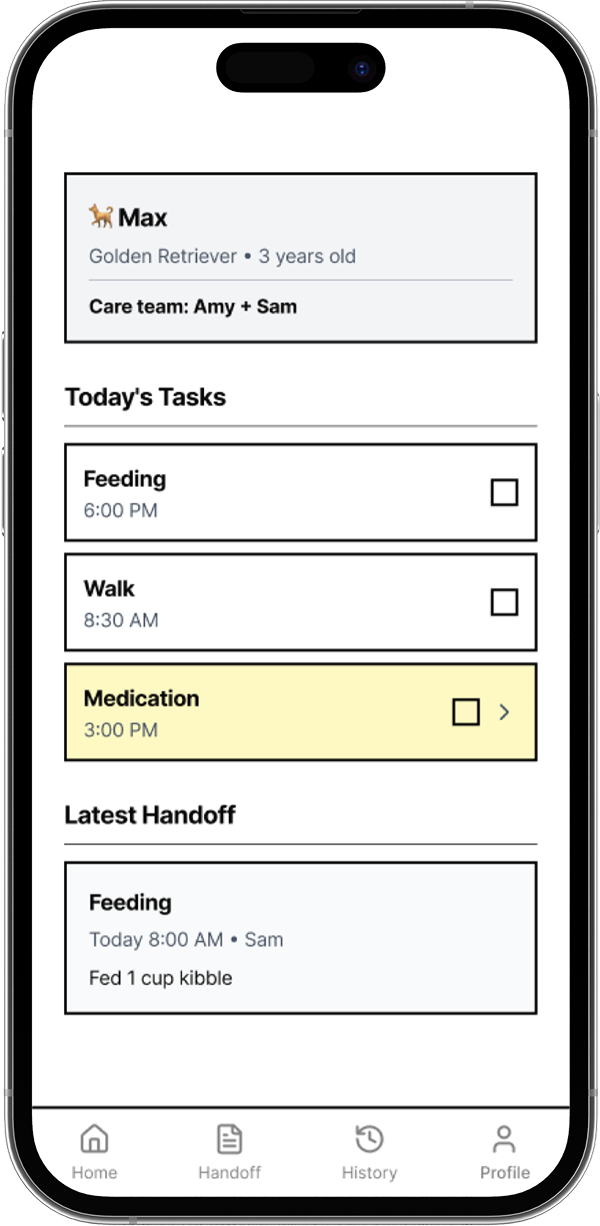
Task Flow 02 · Medication UI
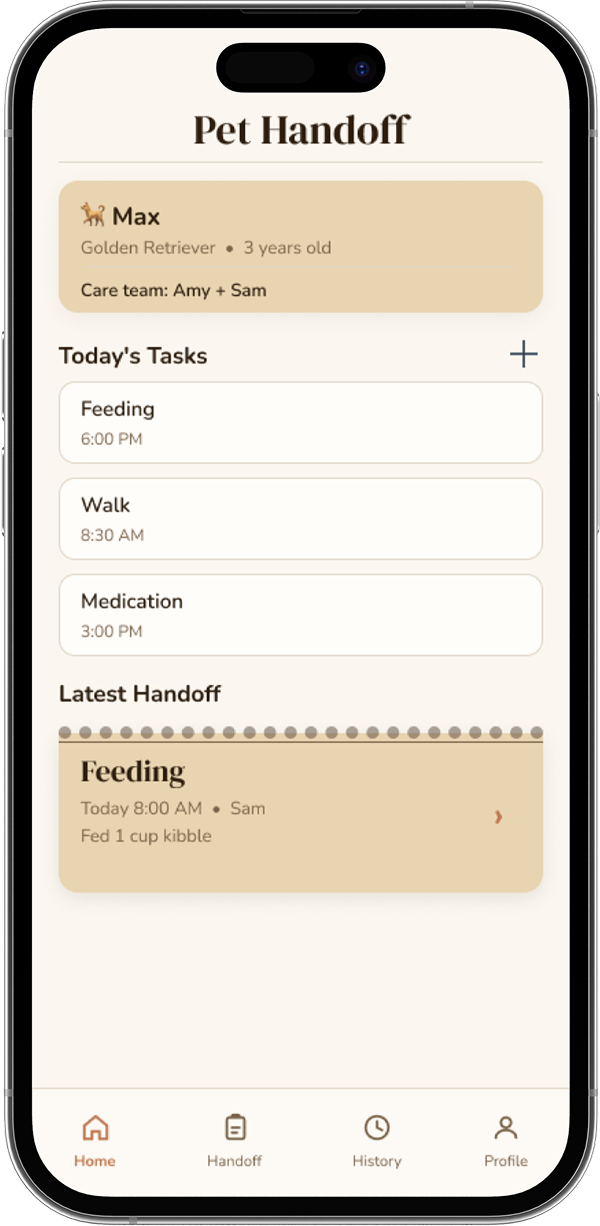
Users were confused by the earlier medication screen because a highlighted task state looked like the main entry point, causing them to tap the wrong element.
Fix: Redesigned the home screen interaction to clarify task actions and remove the misleading highlighted medication entry state.
Before Before redesign
After After redesign
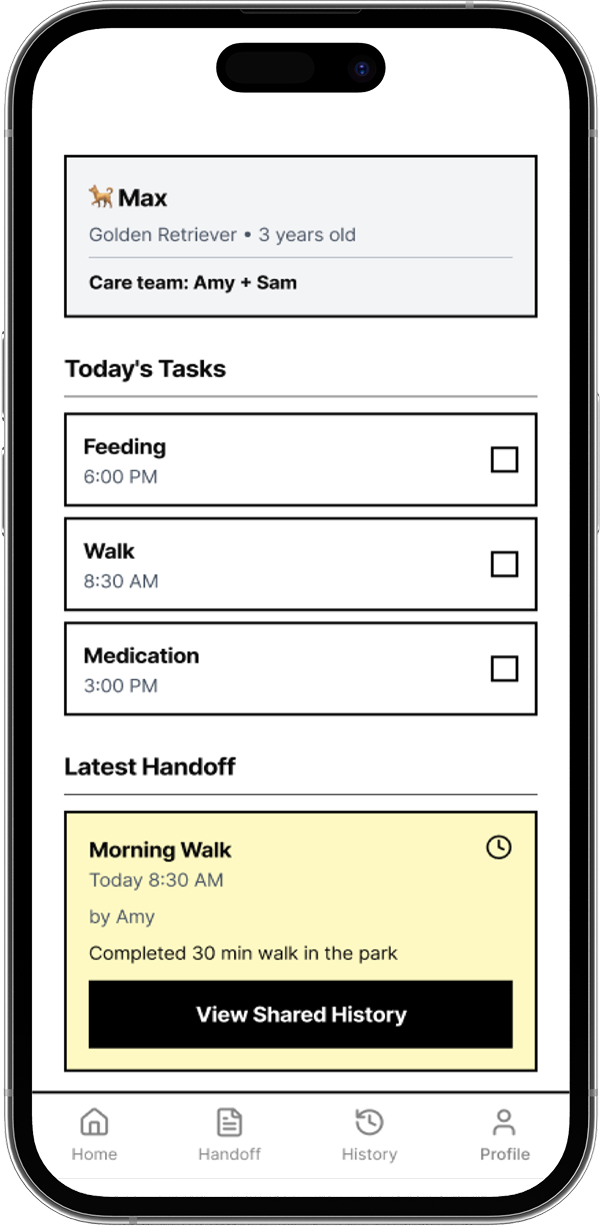
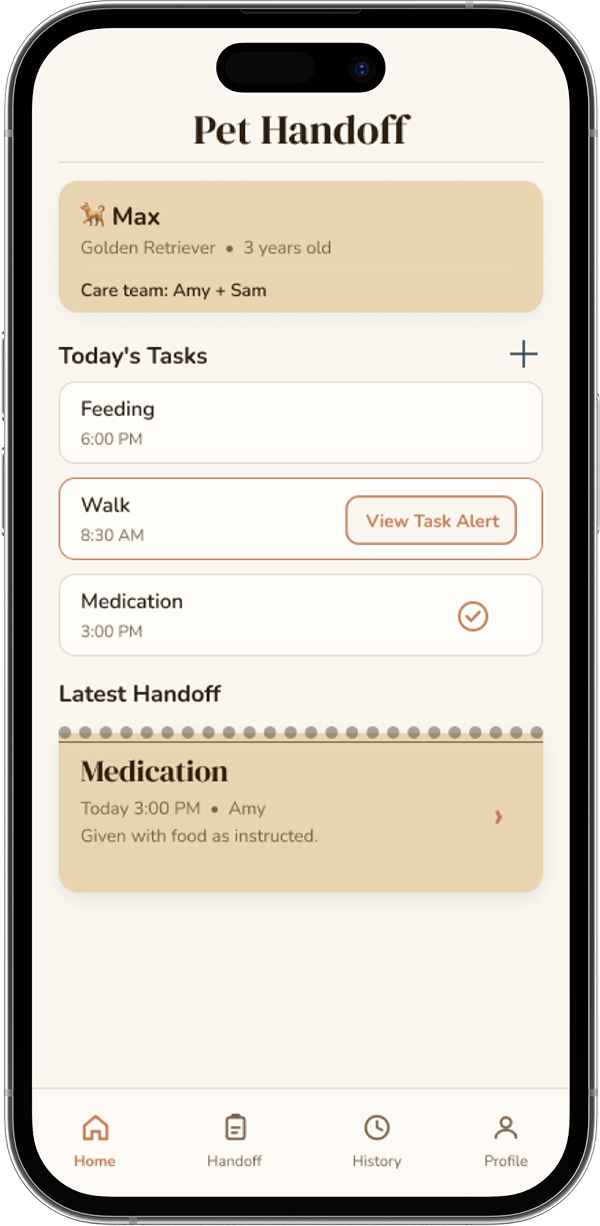
Task Flow 03 · Walk Alert Entry
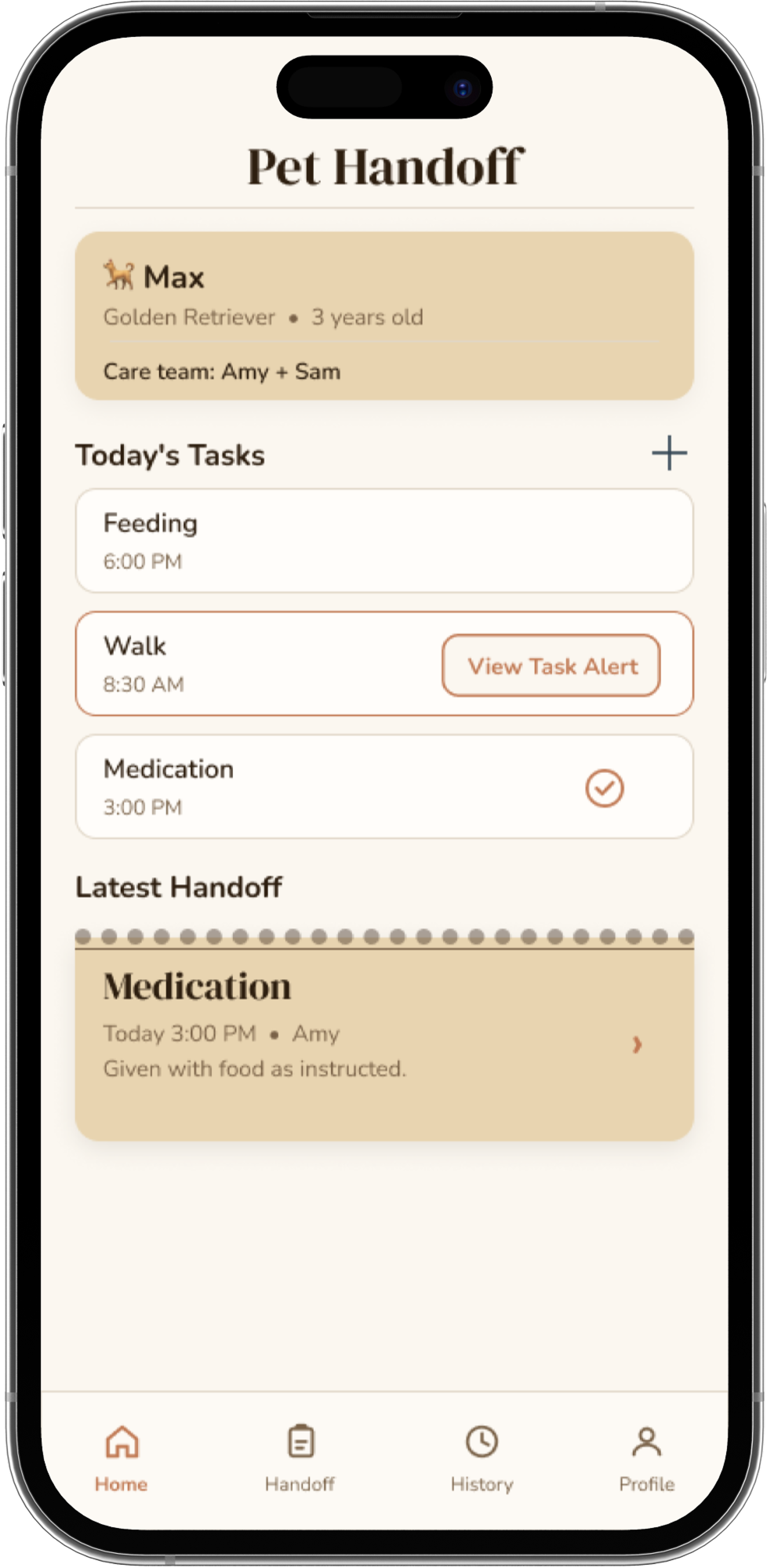
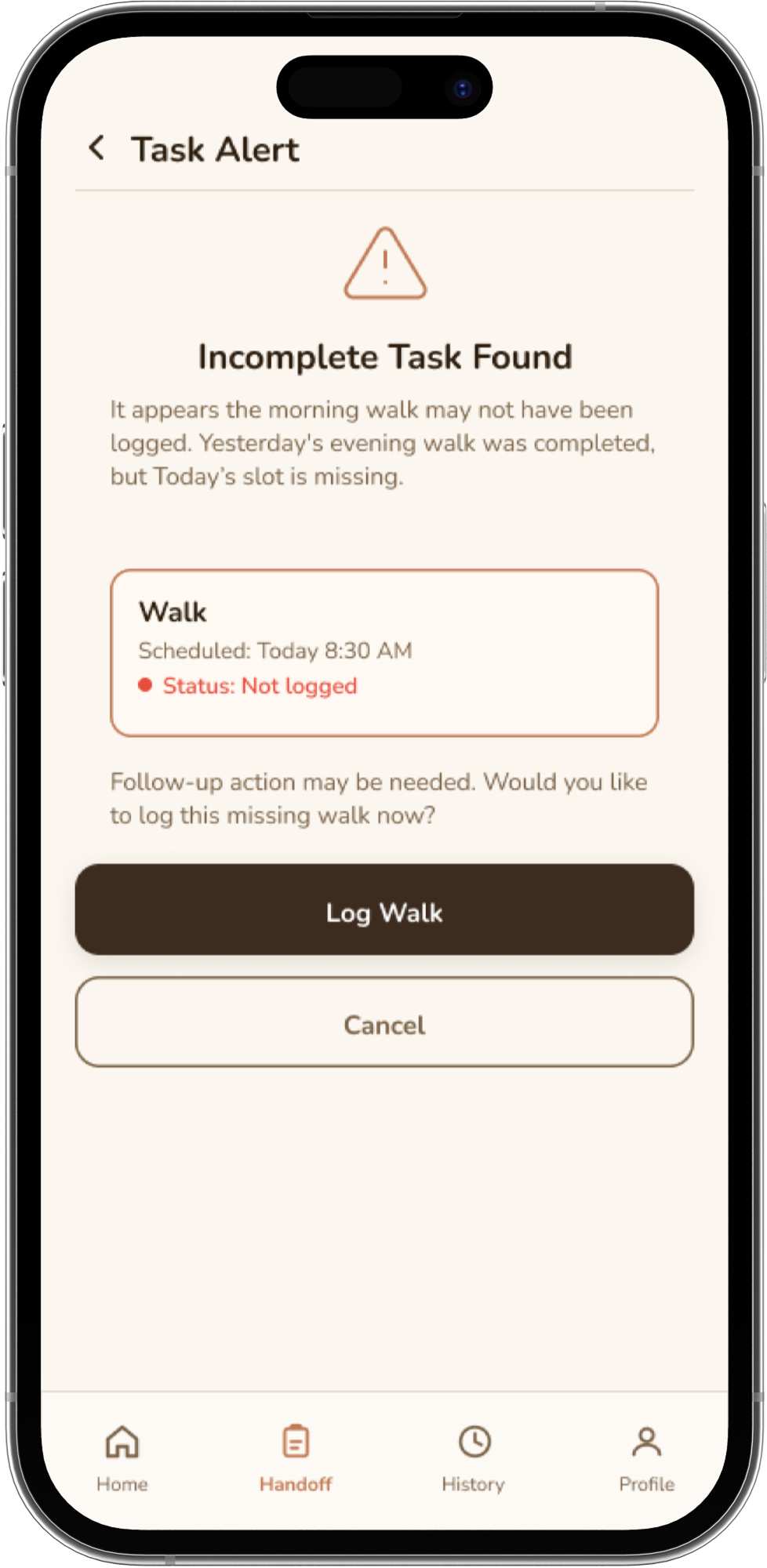
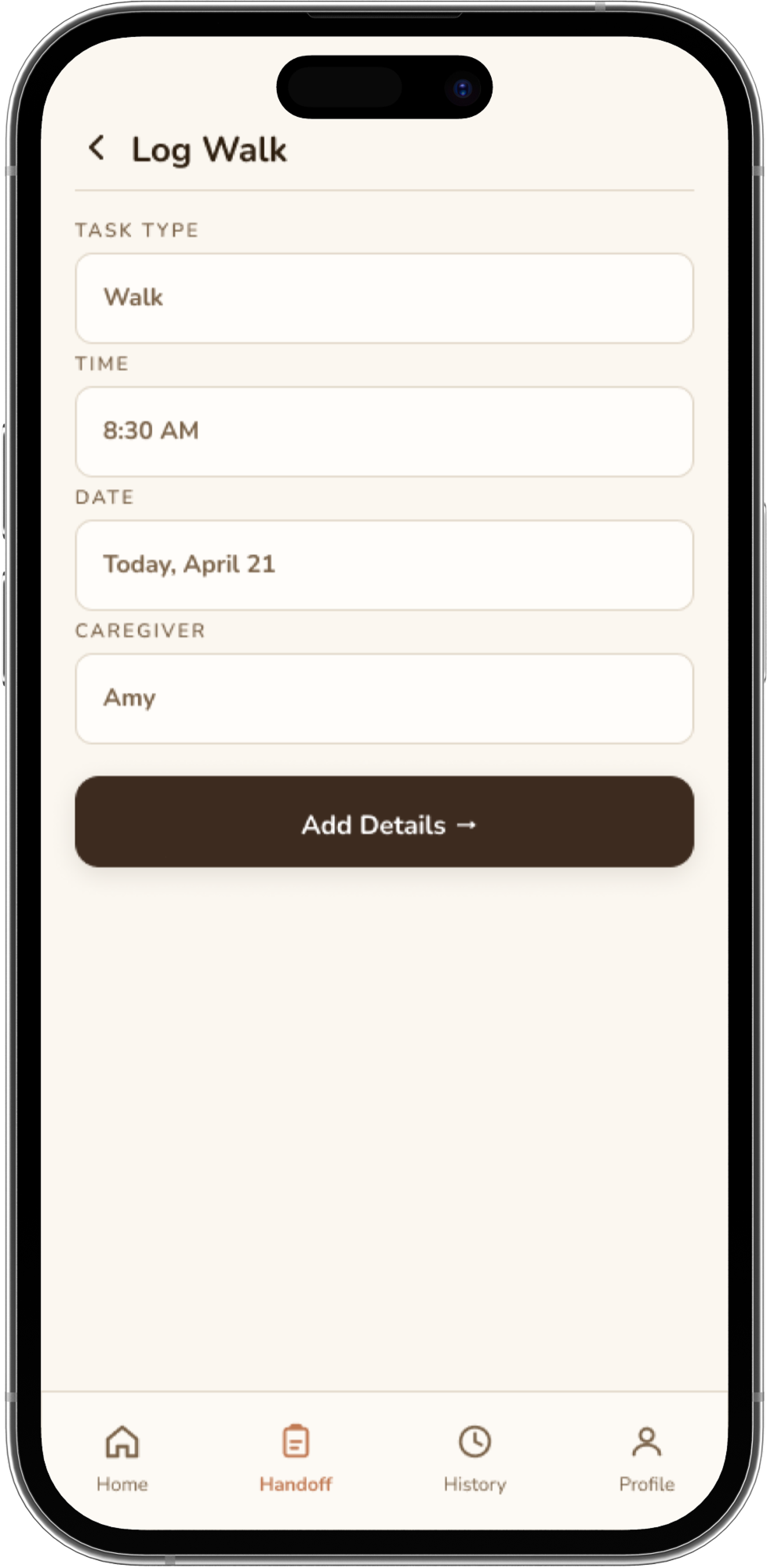
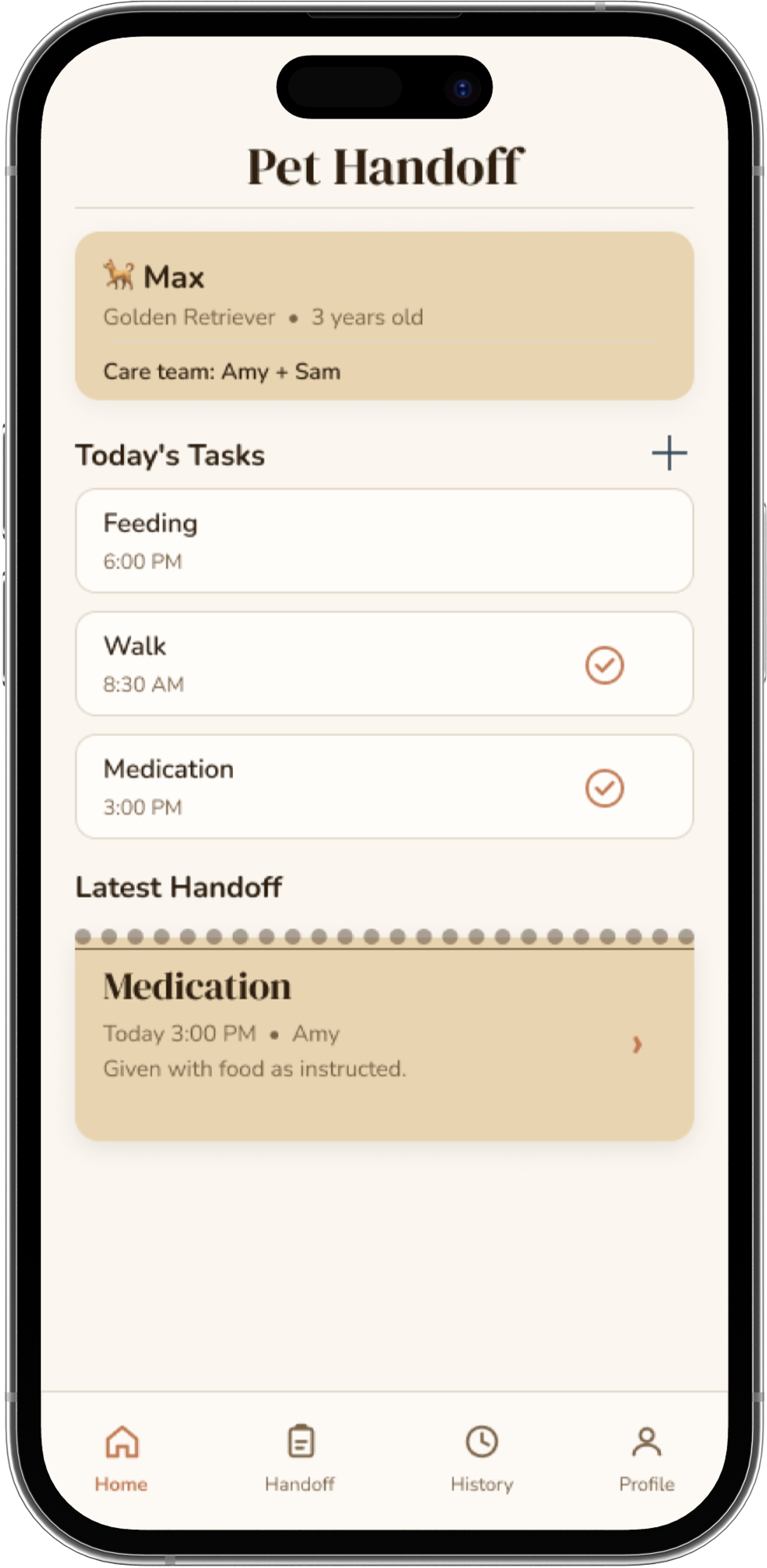
Users couldn't find the missing walk alert flow. The path from the home screen to the alert wasn't obvious.
Fix: Added an explicit "View Task Alert" entry point directly on the Home screen walk task row.
Before Before redesign
After After redesign
Outcome

Final Impact

"I stopped asking 'did you feed her?' I could just check."
0
core task flows (feeding, medication, and walk) fully designed and tested
0
critical UX issues found and resolved through prototype testing
0%
of testers said the handoff record made them feel more confident about shared care
Tester 01 · Feeding Flow
"I finally know what's been done without having to text anyone. The record is just there."
Tester 02 · Medication Flow
"The timestamp makes me feel safe about medication. I know exactly who gave it and when."
Tester 03 · Walk Alert
"The alert made it obvious what was missing. I didn't have to guess or ask. I just fixed it."
Reflection

What I Learned

Making invisible care visible
Trust in shared routines doesn't come from reminders. It comes from being able to see what actually happened. Designing around a visible log changed how I think about accountability in everyday products. You're not building surveillance; you're giving people a reference point so they don't have to keep track in their head.
What I would explore next
If I continued this project, I would explore push notifications for missed task alerts, multi-pet support for households with more than one animal, and how the system could extend to pet sitters or dog walkers who need clear handoff notes from owners before a visit.
Next Project
Smart Ritual →